




Image

How Pet Ownership Teaches Kids Responsibility

National Kids and Pets Day is on April 26th. It’s both a day to celebrate the bond children and pets share but also a day to remember safety where our pets and children are concerned. 

It is important to remember that small children as well as pets may not know their limitations and should not be left alone. Supervision is essential to prevent injury. 


Check out our 5 tips on how pets can teach responsibility: 


1. Chores teach responsibility. Giving your children age appropriate tasks for your four legged family member helps build their self-confidence and is a perfect opportunity to reinforce their independence.  As parents, we know enthusiasm can dwindle when it comes to any chore so don’t be afraid to pull out the sticker chart to help!  

joaquin walk

2. Live an active life. Walking a dog is a fabulous hands-on experience for kids who love pets. With parental accompaniment to ensure their safety, a daily walk can be a rewarding time together with the added benefit of getting some fresh air and exercise for the whole family.

3. Companionship beyond the physical. Pets can fulfill so many psychological needs for children. The unconditional love and affection that pets give children not only boosts their self-esteem but it also helps them make emotional connections of their own. Studies of school-age children in fact have shown those with a pet, tended to be more empathetic and altruistic than those children without a pet, making dogs the perfect teachers of kindness.

Federico

4. Understanding the world. Having children care for pets provides the opportunity to discuss emotions that children often struggle to understand such as growth, accidents and death. Children often surprise us with their resilience but for most kids, the loss of a pet is often their first encounter with death and can be a devastating heartache. Discussing these moments with them helps them not only process the grief but also teaches them emotional skills far greater than their age.   

5. Teaching dog safety. Pets are treasured members of our families and having a pet can teach a child respect by knowing how to treat their own dog and with parental help, this can then be further built on to ensure kids on how to approach strange dogs safely, read their body language and how to behave around pets to ensure safety at all times. 

Alejandro Vet

Help kids and pets learn to be good partners to each other. Use #NationalKidsAndPetsDay and #WellnessPetFood to post on your social media.

5 Ways to Celebrate Earth Day with Your Pets

 Earth Day Tips provided by Wellness Natural Pet Food Partner, TerraCycle.TerraCycle is an innovative recycling company that has become a global leader in recycling hard-to-recycle waste. Wellness Natural Pet Food is the first U.S.-based pet food brand to make its packaging nationally recyclable through a partnership with TerraCycle. So far, the partnership has resulted in 70,000 pet food bags diverted from landfills.

Each year on April 22 the world celebrates Earth Day, a tradition started in 1970 to honor the Earth. During this annual event, people plant trees, take nature walks, host and attend festivals and partake in other activities geared towards raising awareness and support for environmental protection. 

For pet owners, making an effort to improve the health of the earth on this day (and year-round) is easier than ever. 

Here are five ways pet-owners can not only reduce their impacts, but make a positive contribution this Earth Day, and beyond.

Choose biodegradable waste bags:

If you take your pet for a walk (and you’re a responsible pet owner), it is likely that you are carrying a roll of ‘baggies’ to curb your pet and properly dispose of their waste. While your neighbors applaud you, these plastic bags contribute to landfills and take around 400 years to break down. Thankfully, biodegradable and compostable versions of these bags are now available at most grocery and pet stores.

Recycle pet food containers:

People-food packaging will sometimes bear information on their label signifying whether or not it can be recycled curbside; many pet food containers have this messaging, as well. When possible, buy pet food packaged in containers that can be recycled. Aluminum cans and rigid plastic containers are recyclable through many curbside programs, and all Wellness dry food flexible plastic packaging  can be easily recycled through its free TerraCycle program.  

Donate to shelters:

Do you have old towels, sheets, pillows and cases, or worn-out clothes you’ve been meaning to get rid of? There are millions of shelter pets around the country that could use these items in their kennels. Plus, many pet shelters and adoption centers are non-profit and appreciate these donations to help clean and care for the animals. It’s a win-win: you keep these items out of landfills and make someone’s future buddy’s day.

Plant a plant:

Many people celebrate Earth Day by planting a tree. Carry on this tradition by planting pet-friendly plants in your yard. Perhaps your cat would like a catnip plant. Parsley is great for dogs (and humans!) to eat, as are carrots. If space is limited (or you just prefer the ready-made variety), check out Wellness Treats that have these same natural ingredients. 

Get out in nature:

The easiest way to commemorate Earth Day? Just get out in nature, and take your furry companions with you! Skip the car ride (and carbon emissions) by leashing up. And while you’re out there in the fresh air, make a special effort to clean up while you’re visiting. Heading to the beach or woods? Pick up trash you see on the trail. It only takes a few extra moments to do this kind of good deed for the Earth, and you might be surprised to find that others might see your efforts and be inspired to do a cleanup of their own.

Everything You Need to Know About Lyme Disease in Dogs

lyme disease dogs cover photo

Lyme disease is the most common tick-transmitted disease. The effects of this bacterial infection has varying degrees of severity and can lead to major health problems including kidney failure and death. Keep your dog safe by learning what Lyme disease is, the signs and symptoms of it, how to treat it, and when and where it’s most likely to strike.

What is Lyme Diease?

Lyme disease is a bacterial infection transmitted to dogs, horses, some cattle, humans, white-tailed deer, and some rodent species via blacklegged ticks, a particularly small, almost impossible-to-see breed of tick.

Where is Lyme Disease Most Common?

The disease occurs all over the world but was named after Lyme, Connecticut following a tremendous outbreak in the eponymous location in 1975. It is still common in this part of the U.S. According to the CDC, 95% of all confirmed Lyme disease cases stemmed from 14 states:

  • Connecticut
  • Delaware
  • Maine
  • Maryland
  • Massachusetts
  • Minnesota
  • New Hampshire
  • New Jersey
  • New York
  • Pennsylvania
  • Rhode Island
  • Vermont
  • Virginia
  • Wisconsin

Confirmed cases have also been reported in Northern California, Oregon, and Washington. When a host is bitten by an infected tick, the bacteria Borrelia burgdorferi infiltrates the tissue and can cause multiple health problems. Infection does not enter the blood stream until after the infected tick has been attached to the dog for at least 24-36 hours.

What are the Signs & Symptoms of Lyme Disease?

Lyme Disease dog

While it is easy to detect Lyme disease in humans because of the circular red skin rash that appears, it is less detectible in dogs who do not get a rash. What is more, a dog can be infected for two-to-five months before the infection presents signs and symptoms, which include but are not limited to:

  • Lameness (one of the earlier signs)
  • Arthritis
  • Joint pain and swelling (knees and elbows are typically the most affected) 
  • Fever
  • Poor appetite
  • Dehydration
  • Inactivity
  • Swollen lymph nodes
  • Difficulty breathing
  • Sensitivity to touch
  • Depression

Joint pain and swelling (knees and elbows are typically the most affected) 
In rare cases, heart abnormalities and nervous system complications have also been reported. The disease can be difficult to diagnoses as many of the symptoms will present and then appear to resolve. Additionally, these symptoms often mimic the signs of other diseases.

Onset of the disease typically occurs between May and August with the peak months being June and July. Conditions like warmer temperatures, higher humidity, and less rain can cause the season to start sooner. 

woman running with dog

How is Lyme Disease Treated & Prevented?

After Lyme disease was named, the number of reported cases increased dramatically around the world; however, in recent years, the numbers of cases are dropping in some states—particularly those where Lyme disease is a known issue. This is most likely due to increased awareness about the disease as well as proven prevention and treatment options.
For pet owners who live in areas where Lyme disease is prevalent, there are tick-preventative products and vaccination options available through your veterinarian. Your vet will evaluate your dog’s age, overall health, lifestyle, and likelihood of contracting Lyme disease when deciding if a preventative is right for your dog.

Other actions you can take to prevent your pet from getting Lyme disease are:

  • Keeping the lawn trim / mowed
  • Clearing shrubs next to your property
  • Avoiding leaf piles, tall grass, wooded areas, and marshes where ticks tend to gather
  • Search your dog for ticks every day. Check and remove any pests by hand. Use fine-point tweezers to grab the tick as close to your dog’s skin as possible. Gently pull the tick straight up to remove it. You want to avoid tearing the tick as that could lead to wound infection.
  • Explore tick repellent collars, sprays, and other topical options. This could be helpful if being in wooded areas is unavoidable for you and your dog

In the event your dog does get infected, you will need to see a veterinarian for treatment. The vet will provide an antibiotic such as doxycycline. Anti-inflammatories are also helpful for dogs with swelling and arthritic pain. Note that treatment, while effective, does not eliminate the infection, so symptoms may reappear. Kidney disease and other serious negative outcomes are always a potential risk following an infection.

dog lyme disease veterinarian
Note, too, that if your dog is infected that Lyme disease is a reportable disease, which means that its occurrence must be reported to the United States Centers for Disease Control and Prevention (CDC). Reportable diseases are considered to be issues of great health importance. Monitoring these diseases enables researchers and health care professionals to take action and to remain abreast of potential epidemics. 

When it comes to your pet’s health, knowledge is power. Knowing about how to prevent dangerous disease like Lyme disease is one form of power. Another is knowing that a healthy, all-natural diet like those provided by Wellness Pet Food will help your dog live a longer, happier, more energized life. 

DIY: What Every Pet First Aid Kit Needs to Have

diy pet first aid kit blog cover photo

Pet first aid kits are essential for every pet owner to have. Access to the right supplies when a crisis strikes can save your pet’s life. Learn what a pet first aid kit is, why you should have one, and where you should keep it.

What Is a Pet First Aid Kit?

A pet first aid kit is a collection of materials useful in a medical emergency. These resources are helpful for minimizing the effects of an incident before you seek professional medical help from your veterinarian or emergency vet.

What Your Pet First Aid Kit Should Have in It & How to DIY a Pet First Aid Kit

While pet first aid kits come pre-assembled, the benefit of building your own is that you know exactly what is in it and where the items are.

You can easily create a DIY pet first aid kit

Step 1: Gather the materials every pet first aid kit needs.

  • Paperwork & records such as your pet’s ID card with your name and address, the veterinarian’s number, the emergency vet clinic’s number, and the number for animal poison control (888-426-4435), a copy of your pet’s medical history, and list of vaccinations with dates
  • Remedies such as medications, flea treatments, sterile saline eye wash, dish soap for removing toxins from the skin and fur, milk of magnesia for absorbing poison, and hydrogen peroxide (3%) to induce vomiting (note to contact the vet or poison control center before inducing vomiting or administering treatment for poisoning with milk of magnesia)

diy pet first aid kit

  • Wound supplies like wound spray, Q-tips, gauze bandage, nonstick bandages, adhesive tape for bandages, wipes, and a Ziploc bag
  • Tools like a flashlight and tweezers, an emergency muzzle (nylon hosiery works well), a nylon leash, eye dropper for flushing wounds or giving oral medication, digital thermometer, and scissors for cutting tape
  • It also doesn’t hurt to have treats on hand or as part of the kit to soothe a pet that has been traumatized by a situation that requires emergency medical attention (provided your pet is okay and can eat).

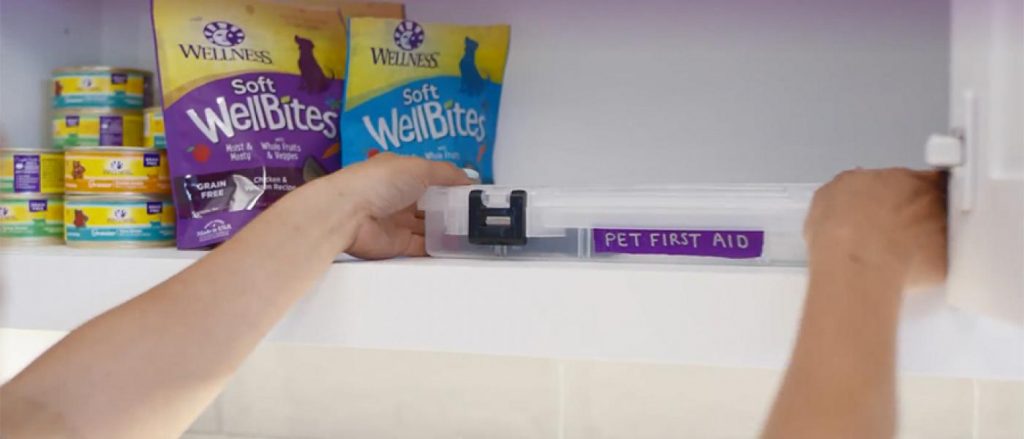
Step 2: Package the materials in an easy-to-grab-and-go clear tackle box.

This enables you to keep the supplies organized, to see what you are out of or are missing, and to get materials faster when you need them.

Step 3: Place labels over each section of the tackle box. 

When there is a crisis, time is often of the essence.

pet getting bandage

Step 4: Store the box in a handy location

You may choose a cabinet where you keep other pet supplies. It does not hurt to have a separate DIY kit for the car as most materials are low-cost and can—as noted—make a huge difference in an emergency. 

Having the right materials on hand can be the difference between life or death for your pet, so if you don’t already have one, make a pet first aid kit now.

husky dog with bandage on nose
Pet first aid can save animal lives, and so can good nutrition. A balanced diet of natural ingredients like those made at Wellness Pet Food help to ensure a longer, healthier, and happier life for your pet.

6 Proven Breed Stereotypes from a Professed Siamese Cat Fanatic

Maria is a graphic designer at WellPet. When she isn’t working and cuddling with her Siamese Mogwaii, you can most likely find her at a concert or local Pure Barre studio.

1. They’re one of the oldest and most recognizable cat breeds.

Breed variations include Blue, Chocolate and Lilac Siamese cats. Mogwaii is a Lilac Point Siamese. The gene that causes the pointed color pattern is all responsible for the blue color of the eyes that is one of the characteristics that makes Siamese different than other breeds.

Siamese Cat Lilac Point

Look at those lovely lilac ears!

2. They love to talk!

Known as total chatterboxes (for good reason), Siamese cats are known to strike up conversations over just about anything! In fact, their long, drawn-out meows sometimes sound like a human baby’s cry. Here, Mogwaii’s letting me know that he wasn’t pleased about his recent trip to the veterinarian:

3. They’re needy.

Well isn’t this the truth! Mogwaii gets pretty creative in telling me that I’m ignoring him by knocking all my stuff down and unplugging my laptop:

4. They’re affectionate, friendly, loyal and bold.

From sleeping in bed with me each night, to snuggling on the couch at the end of a long day, there’s never a time I’m home when Mogwaii isn’t right by my side.

Affectionate Siamese Cat

5. They crave companionship.

True to what the professionals say, I’ve experienced that Siamese cats form extremely close bonds with their primary caretaker–in this case, me! Mogwaii will follow me from room to room and needs to be involved in anything and everything I’m doing.

Siamese cat looking at computer screen

Mogwaii is assisting and keeping me company while I work.

6. They’re smarty-pants.

Siamese cats are known for their intelligence; they are highly trainable. Their behavior is described as being more dog-like than cat-like. Unfortunately, Siamese cats are prone to asthma and bronchial illnesses. True to his breed, Mogwaii has been diagnosed with asthma. We treat his asthma using an inhaler with a special attachment for kitties. Since he’s so smart, we’re able to train him to sit for his inhaler which we follow up with Wellness Kittles–his favorite treat!

Although every cat is different in personality, we couldn’t help but highlight some of the quirky “cat-eristics” that make Siamese cats so special! Happy National Siamese Cat Day!

Top 10 Pet Instagram Accounts of 2018

10. @zammypup (instagram.com/zammypup)

Our #10 spot goes to Instagram’s biggest teddy bear: Zammy! Hugs are always on the menu with this pup around. Zammy even visits children’s hospitals where he spreads his good boy cheer as a therapy dog. If you’re ever in need of some Vitamin Z, get a big ol’ virtual hug from Zammy and he’ll fix you right up!


9. @the_island_dog (instagram.com/the_island_dog)

Our #9 spot goes to Instagram’s most spoiled pups: Santo & Marla! These two raw fed pups are living the good boy life in paradise and making everybody and their uncle heckin jealous! They’ve got pictures of pups at tropical beaches, tropical beaches with pups, pups on tropical beaches, and oh did I mention tropical beaches?? If you ever wanted to live vicariously through an account, this is the one!

german shepherds

8. @k9_jester (instagram.com/k9_jester)

Our #8 spot goes to Instagram’s most loved police K-9: Jester! Ever wondered what life is like for the good boys in blue? Well throw this pup a follow and you’ll find out! Although he’s a pup of many tricks, his hat trick is tricked out hats! Oh and just a quick PSA, stay on the straight and narrow or you’ll meet Jester under very different and unpleasant circumstances!

k9 jeste

7. @lacorgi (instagram.com/lacorgi)

Our #7 spot goes to Instagram’s most adorable loaf of bread: Geordi! If you’re looking for a personal trainer or booty model, look no further than this pup! Careful though if you and your gf ever run into Geordi in spin class. He may not be 6 foot, but he will steal your girl! 

geordi leg lift


6. @my_aussie_gal (instagram.com/my_aussie_gal)

Our #6 spot goes to Instagram’s most well trained pup: Secret! Ever wanted to see a dog do yoga, ski a hill on a sled, or dance to an Irish folk tune? Well you’re in luck ’cause this pup does it all! It’s no secret that Secret’s destined for stardom!

doga secret

5. @mayapolarbear (instagram.com/mayapolarbear)

Our #5 spot goes to Instagram’s most happy cloud: Maya! She loves trying new foods, makeup tutorials, and borking out a good howl! Although Samoyed accounts are few and far between on Instagram, she’s quickly changing that. According to many eyewitness accounts, every viewer who’s ever scrolled through Maya’s page immediately googles “WHERE CAN I GET MY PAWS ON A SAMOYED??”

maya polar bear

4. @thehuskyjoey (instagram.com/thehuskyjoey)

Our #4 spot goes to Instagram’s most photogenic husky: Joey! This pup is never shy of the camera! Her stoic poses and gripping gaze will leave you breathless as if she’s staring into your soul and judging every bad decision you’ve ever made. If she were a hooman, she’d be Beyonce.

the husky joey

3. @wat.ki (instagram.com/wat.ki)

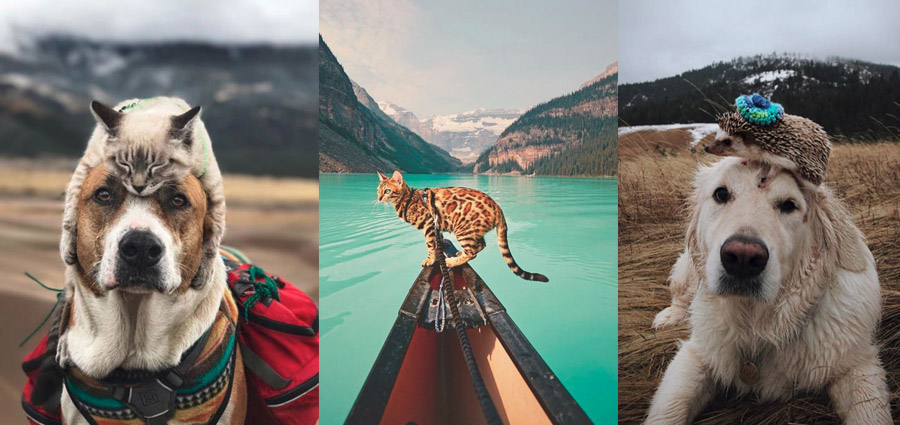
Our #3 spot goes to Instagram’s most adorable pet family: Watson, Kiko, Harry, and London! What started off with just one pup quickly led to another dog, a cat, and now a hedgehog with each member having their own signature trait. Watson loves trust falls, Kiko loves hugs, Harry loves snuggles, and London just loves to look sharp. With all these animals under one woof, you could say it’s a full house!

gif wat ki

2. @henrythecoloradodog (instagram.com/henrythecoloradodog)

Our #2 spot goes to Instagram’s most famous adventure duo: Henry and Baloo! Coming from humble beginnings, Henry and Baloo are both rescues and when they left the pound they never looked back. The two have been climbing mountains and camping under the stars as a team ever since! Henry and Baloo have stolen so many hearts that it ought to be a crime!

henry colorado dog

1. @sukiicat (instagram.com/sukiicat)

Our #1 spot goes to Instagram’s most famous adventure cat: Suki! With an abnormal obsession for water, long hikes, and road trips she’s not your average bengal cat. She’s hiked mountains, forged streams, explored forests, and wandered deserts. You name it, she’s done it. And her fashion game is just as strong. Whether it’s a norwegian sweater or wool blanket, this cat hits the trail with style. By combining beautiful photography with an equally beautiful jungle cat, Suki is surely bound for big things! Ain’t no mountain high enough for this adventure kitty!

sukki cat


DISCLAIMER: These accounts are in no way affiliated with Wellness Natural Pet Food. 

A Veterinarian’s Top 5 Easter Hazards for Pets

easter dog

Spring is here and nothing is more wonderful than the warmer weather, amazing flower blooms, open grass fields, trips to the park, long blissful walks and runs, and Easter! There is just something about Easter that brings a sense of warmth, color, and vibrancy to the air. I love the bright color decorations, the beautiful spring colored décor, and of course all the flowers. As a small animal veterinarian, I know too well how much our beloved pets love the outdoors and holiday festivities. As pet parents, it is so important to be aware of which flowers are safe and which ones can be toxic for your pets, as well as other potential dangers associated with Easter. As the holiday approaches, I wanted to discuss the dangers of Easter for our pets and how we can protect them. Let’s get started:

Easter Lilies:

Easter lilies
Lilies from the Lilium or Hemerocallis plant are toxic for cats. Easter lilies belong in this family and are a common decoration during the holiday season and on sale in every store. Easter lilies are a threat to your cat and can be fatal if ingested. All aspects of the flower (petals, stems, leaves, and pollen) have the potential to harm your cat. The toxic effects of Easter lilies result in severe gastrointestinal upset, but if left untreated can result in kidney failure and death.  Although Easter lilies are the most common type of lilies during this time of year, other lilies that are also toxic to your pets are tiger lilies, rubrum lilies, Asiatic hybrid lilies, Japanese show lilies, Stargazer lilies, Red lilies, Western lilies, Wood lilies
What are the signs and symptoms of Easter lily Toxicity?
Within 2 to 4 hour of ingestion the most common clinical signs are:

  • Vomiting
  • Loss of appetite
  • Lethargy
  • Drooling
  • Within 24 to 48 hours if ingestion the most common clinical signs are:
  • Anorexia
  • Hiding
  • Increased drinking and urinating
  • Halitosis
  • Painful abdomen
  • If toxicity progresses to end stage renal failure, decreased or stop urinating

Time is of the essence in treating Easter lily toxicity. If you believe your cat has digested an Easter Lily, please seek veterinary care immediately.

Chocolate:


Chocolate contains two ingredients that are toxic in large quantities: theobromide and caffeine. Different types of chocolate contain different amounts of theobromide and caffeine; therefore, the amount and the type of chocolate your pet eats play a role in its toxic effects. Toxic doses of theobromine (the active ingredient in chocolate that is toxic) are 9 mg per pound of dog for mild signs, and up to 18 mg per pound of dog for severe signs. Milk chocolate contains 44 mg per ounce of theobromine while semisweet chocolate contains 150 mg per ounce. Baking chocolate contains the most at 390 mg per ounce.
What are the clinical signs of chocolate toxicity:

  • Diarrhea/vomiting from the high-fat content in the chocolate
  • Restlessness
  • Hyperactivity
  • Muscle twitching, tremors
  • Increased drinking and urination
  • Excessive panting
  • Irritability
  • Increased heart rate and abnormal heart rhythm
  • In extreme situations, seizures, collapse, and even death can occur.

If your dog or cat has ingested chocolate, you should contact your veterinarian immediately. Many times we can assess on the phone how much they ingested, and assure you it is not enough to cause a toxicity. However, if your pup did ingest chocolate, we can initiate treatment immediately by inducing vomiting, administering IV fluids, and monitoring during hospitalization.

Xylitol:

 
Xylitol is an artificial sweetener used in many sugar-free gums, candies, baked goods, and mouth washes.  When your pet ingests xylitol or xylitol containing products, it causes a rapid release of the hormone insulin, resulting in a sudden decrease in the blood glucose.
What are the clinical signs of xylitol toxicity:

  • Lethargy
  • Vomiting
  • Loss of coordination
  • Collapse
  • Seizures
  • Severe cases, liver failure

Be aware of any candies or foods that may contain xylitol and keep them far out of the reach of your pet. If your dog or cat has ingested xylitol, you should contact your veterinarian immediately.

Easter Decorations:

Easter-basket
Easter Basket Fillers- plastic Easter grass, plastic eggs, foil wrapping, and toys are very enticing for pets.  These decorations, if ingested in large quantities, can result in serious health problems such as mechanical obstruction, gastroenteritis (upset belly), and pancreatitis. I have performed emergency surgeries on many pets that have ingested these materials.  Make sure to keep the Easter baskets and decorations far out of reach of your pets.

Fatty Foods


It is the holiday and hosting parties with friends and family are always a big part of the festivities.  Be careful with allowing your pet to eat the Easter delights. This is a common time of year where I evaluate many fur babies at my animal hospital for an upset belly. Fatty foods that are often served during Easter festivities, such as ham and lamb, can cause problems ranging from stomach upset to more serious illnesses such as pancreatitis, resulting in pain, vomiting, and dehydration.
There is no need for your pets to feel left out. Let them indulge on Easter! I tell all my pet parents to have treats and food easily accessible during the holiday festivities and spoil your pets rotten. I absolutely love and trust Wellness CORE and it is what feed my own dog. Wellness CORE is a balanced diet that is grain free, contains all the highest quality ingredients, added supplements (omega 3 fatty acids, and glucosamine), and higher protein for lean body mass and muscle tone.
Spring is the best time of year and Easter is such a wonderful holiday. I hope this article is helpful in informing my pet parents of the dangers of pet Easter toxicities lilies and helps you to enjoy the holiday to its fullest. As always, your pets overall health and well being is my top priority. Knowledge of the dangers of Easter hazards and prevention is key to keeping your pet safe. Happy Easter!

Your Complete Pet Poison Prevention Guide

pet poison header

March is Pet Poison Prevention Month. There are many foods, chemicals, and other materials around your house that are safe for you but not for your pets. Print this one-page at-a-glance guide and hang it on your fridge for a year-round reminder of the foods and substances to keep away from your pets.

Foods & Beverages

  • Alcohol
  • Chocolate
  • Coffee / Caffeine
  • Citrus leaves, peel, seeds, and stems
  • Coconut and coconut oil
  • Grapes and raisins
  • Avocados
  • Macadamia nuts
  • Milk and dairy
  • Nuts
  • Onions, garlic, and chives
  • Undercooked or raw meat
  • Raw eggs
  • Bones from meat
  • Snack foods
  • The sweetener Xylitol found in candy, gum, baked goods and tooth paste
  • Yeast dough 

dog chocolate

Common Plants

  • Aloe Vera
  • Baby’s Breath
  • Ivy
  • Hostas
  • Sago Palm
  • Tomato plants
  • Poinsettia
  • Lilies
  • Gladiolas
  • Carnations
  • Begonias
  • Tulips
  • Daffodils 
  • Mums
  • Ivy
  • Wisteria
  • Lantana
  • Yew
  • Azaleas
  • Hydrangeas
  • Boxwoods
  • Elephant ears
  • Angel trumpets
  • Castor bean 

aloe plant

There are over 1,000 plants poisonous to pets. These are some of the most common. A best practice is to assume all plants are poisonous and to research the effects on pets before putting them indoors or growing them outdoors.

Other Indoor & Outdoor Poisons 

  • Human medications
  • Overdose of pet medications
  • Insecticides 
  • Rodenticides
  • Fertilizers
  • Weed killers
  • Cocoa mulch
  • Compost piles
  • Antifreeze 
  • Pool cleaning chemicals such as chlorine
  • Self-cleaning oven odors
  • Lead paint chips
  • Linoleum
  • Indoors cleaning chemicals
  • Bleach
  • Detergent 

pills

What to Do if Your Pet is Poisoned

If your pet is poisoned, you need to be able to tell the emergency specialist what your pet ate, when (i.e., how long ago), and how much of the substance your pet ate. Do not wait until your pet starts to exhibit signs of poisoning before you call for help. 

Signs of poisoning include vomiting, diarrhea, seizures, bloody stools, lethargy, poor appetite, irregular heartbeat, nosebleeds, or inability to use the restroom. Exhibition of these signs could indicate your pet has ingested poison without your knowing.

Emergency Numbers:

ASPCA Animal Poison Control Center hotline: 888-426-4435

Pet Poison Helpline: 800-213-6680 or 855-764-7661 (You will be asked to pay a consultation fee)

hotline

Do not ever attempt to self-treat your pet without talking to a poison control specialist first. Specifically, do not try to feet your pet milk, food, salt, oil or other home remedies, according to Pet Poison Helpline. Do not attempt to induce vomiting with hydrogen peroxide, milk of magnesia, or some other method without consulting a poison control specialist or your veterinarian first. Any effort made without the oversight of a professional could make matters worse.

After consulting with a professional, if an examination following a poisoning incident is needed, take the package or some of the poisonous substance with you to the veterinarian’s office if possible.
 
In addition to keeping dangerous substances out of reach, feed your pet well. If your pet is full and content as a result of a fulfilling, all-natural diet, like the ones supported by Wellness Pet Foods, then they might be less likely to sample poisonous foods, plants, and other chemicals when they encounter them.


5 of the Most Inspiring K9 Veterans

National K9 Veteran’s Day is March 13, which is the US Army K9 Corps’ official birthday. Brave, wise, and compassionate dogs routinely serve alongside military and law enforcement. This year, we’re celebrating by recounting some of history’s and modern day’s most inspiring K9 Veteran stories.

1. Sallie Ann Jarrett, the Civil War Guard Dog


The Pit Bull Terrier Sallie Ann was raised alongside the soldiers of the 11th Pennsylvania Infantry in Philadelphia. The warm air was balmy the summer of 1863. Rains made the grounds muddy and hard to traverse. Rivers were swollen, and tensions were high as the soldiers marched into one of the American Civil War’s most pivotal battles: The Battle of Gettysburg. Alongside the war-weary soldiers, Sallie Ann Jarrett trampled along playfully, yipping and chasing game…distracting the soldiers from the reality of war and the possibility of their own mortality. 
It was the first day of battle at Gettysburg, and as the gunfire began, Sallie Ann and her regiment became separated. Many assumed that Sallie Ann had gone the way of many of their brethren soldiers and was dead; however, Sallie Ann wasn’t dead; rather, several days later, she was found steadfastly protecting those in her regiment who were dead and wounded. 
A monument bearing Sallie Ann’s image was erected in Gettysburg. Sallie Ann faithfully served her country and its men until the Battle of Hatcher’s Run in February 1865 when she was shot and killed. Rest in peace, brave girl. We salute you.

2. Sergeant Stubby, the Stray-Turned-WWI K9 Veteran

Sergeant Stubby in uniform


With his big, soulful eyes, terrier mix Stubby looks more like Little Timmy’s trusty sidekick, but Stubby’s sidekick duties were fulfilled with GI Joes training in New Haven, CT. From Connecticut, Stubby made his way to France as part of the 102nd Infantry, 26th Yankee Division.  Stubby served his unit well by rounding up German spies, finding missing soldiers between trenches, and detecting pending gas attacks. When he wasn’t saving lives, Stubby kept everyone’s chins up making him the ultimate wartime pal. 
After World War I ended, Stubby was given a medal, led parades, met presidents, and was made the mascot of Washington D.C.’s Georgetown University. Stubby’s the heroic stray that wandered right into America’s hearts.

3. Smoky, the Yorkshire Terrier from a Foxhole in New Guinea during WWII

Despite being only four pounds, Smoky, the Yorkshire Terrier that was adopted by soldiers after they found her in a foxhole in New Guinea paid their kindness back 70-fold. Specifically, she ran phone wiring 70-feet underground enabling essential communications between outposts.
After her time in active combat, Smoky served as a therapy dog at Australian Army and Navy / Marine hospitals giving her the distinction of being the first therapy dog. Smoky passed away in 1957 but is memorialized with a statue in Cleveland, OH. When it comes to bravery and loyalty, Smoky proves size doesn’t matter.

4. Dexter, the Sharp German Shepherd from Iraq 

Dexter being welcomed home


Dexter, the German Shepherd, is a Navy Veteran who served with handler Petty Officer 1st Class Kathleen Ellison. Dexter has the distinction of being the first military K9 to get an American Legion Post 703 membership card. The honor is much-deserved as Dexter saved multiple U.S. servicemen and women’s lives in Baghdad when he detected explosives in a garbage truck’s gas tank. The garbage truck was targeted at a mess hall where countless men and women were dining. 
After his tour in Iraq, Dexter was rewarded in an award ceremony with a giant bone and a 2-pound steak. Dexter retired in a community of other retired K9 Veterans where constant care is provided. It was a much-deserved quiet end to an impressive career.

5. Rex, the Best in His Class in Operation Iraqi Freedom II

German Shepherd veteran, Rex

During training, German Shepherd Rex was best in his class; he handled his first mission like a pro—not barking at stray dogs in Baghdad while on an overnight mission to flush insurgents out of a building stocked with munitions and explosives, obeying orders, and not yelping and giving away the team’s position when cut by wire fencing. 
That mission was a success, but on a later mission during his third tour, things didn’t go so well. Rex and his handler reached a checkpoint when their worlds were literally turned upside down. As they moved through the checkpoint, an improvised explosive device buried deep underground triggered and exploded literally blowing Rex and his handler up. The pair flew an estimated 30 feet and miraculously, survived with only minor wounds. 
In his career, Rex spent 25 months detecting countless explosives and munitions and saving multiple lives by doing so. The love, sacrifice, and service of K9 Veteran blow us away, and we couldn’t be more impressed by these and other four-legged heroes this K9 Veteran’s Day.   
These and other K9 service dogs deserve to be celebrated every day. In fact, all dogs do, which is why Wellness Pet Food continually makes all-natural dog foods that will ensure your dog, the hero of your heart, is strong and healthy and ready to fight another day.

.

How to Find a Pet Sitter You’ll Feel Great About

Pet Sitter Photo

When pet owners travel, they cannot always take their four-legged family members and when such occasions arise, pet owners need to be able to have a reliable caretaker available for their pets if they do not want to board their pets. Many pet owners rely on neighbors to watch their pets while they are away for extended periods; however, a neighbor, friend, or family member usually don’t have the time to spend taking proper care of your pet, which is why you should consider hiring a professional pet sitter. 

What is a Professional Pet Sitter?

Professional pet sitters are more than animal lovers; they are knowledgeable, accessible pet care providers who are also certified by the National Association of Professional Pet Sitters (NAPPS) or Pet Sitters International (PSI). Professional pet sitters:

  • Administer medications to pets
  • Understand how to recognize when a cat, dog, or other type of pet is ill or has a parasite
  • Are familiar with ailments common to certain breeds
  • Have experience walking pets on leashes and know what kind of leash and harness is appropriate for different sizes of dogs
  • Knowledgeable in pet first aid
  • Often are trained to respond if there is an accident or unexpected loss.

Professional pet sitters also conduct themselves as professionals; for them, pet sitting is a business, which means whatever schedule you and the pet sitter arrange for your pet’s care, they adhere to. Truly dedicated professional pet sitters will also send you photos of your pet while you are away, which gives you peace of mind.

dogs on luggage


When to Hire a Pet Sitter

Any time you leave your pet for an extended period (overnight or longer), you need to make arrangements for your pet’s care. Animals not only need to be fed and cleaned up after, but they also need exercise and socialization. Some busy pet owners even hire pet sitters to walk their pet during the day or in the evenings before they arrive home from work to ensure their pet gets regular exercise and interaction. Additionally, some pet owners will take their pets with them when they travel and will hire a pet sitter to help care for their pet while they are traveling.

Why You Should Hire a Professional Pet Sitter

As noted, friends, family, and neighbors might not have time to do more than drop in once a day and check on your pet whereas a professional pet sitter will. They also might not have the expertise necessary to realize if something isn’t right about your pet (i.e., they seem ill, are not eating properly, are scratching excessively, etc.). Perhaps more importantly, these people might not be accessible if you have to leave town due to emergency circumstances. By having a pet sitter (or two) available, then you know you will be able to hire someone who can reliably take care of your pet in a pinch.

How to Find a Professional Pet Sitter

When it comes to finding a certified pet sitter, there are many ways to find someone. Here are a few options :

  • ask friends who have hired pet sitters for recommendations
  • ask your veterinarian for a recommendation
  • search online at sites like Pet Sitters International, PetSitter.com, Rover.com, and Care.com to list a few

When you find someone, ask for their resume. 

Confirm  that they have a certification (if that is important to you). Discuss the specifics of the care they will provide.

  • For example, ask how long they can visit with your pet and how often. 
  • Find out their typical schedule of availability; some pet care professionals are full-time while others do it part time because they love pets. 
  • Discuss emergency care plans and confirm that the person you are hiring is physically fit enough to properly care for your pet (this is important if you have a large dog).
  • Confirm they are comfortable administering medication to your pet.
  • Lastly, create a contract for long-term care provisions to cover both of your interests in the event that something happens to your pet or the provider while taking care of your pet. 

Professional pet sitters work in almost every city throughout the country and around the world making it easy for you to have or to find an experienced pet care provider for when you’re working long hours, are away from home, or are traveling and have your pet with you. 


pet sitter checklist


What you feed your pet is as important as who is taking care of your pet, which is why we at Wellness Pet Food aim to create all-natural pet foods that ensure you don’t have to worry if your pet is getting the right nutrients. When they eat Wellness, you know that they are. 

About This Page

Pet Type:

Topic:

その他 健康と栄養

Date:

01/03/2018

    Be the best pet parent you can be. Join for expert advice.

    Sign Up